India's AI talent shortage is a screening problem
August 21, 2026
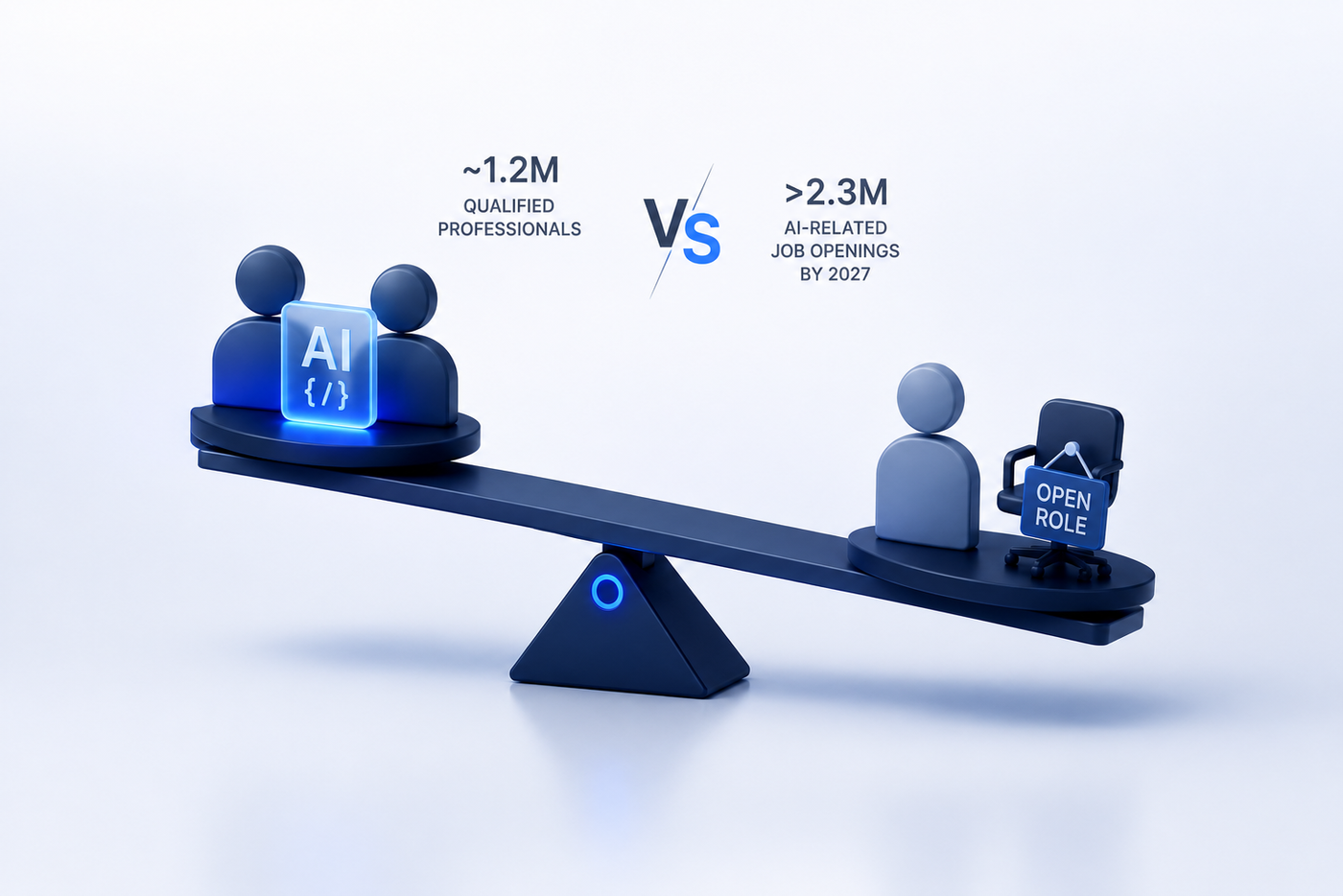
Bain's 2025 analysis projects over 2.3 million AI-related job openings in India by 2027, against a pool of roughly 1.2 million professionals qualified to fill them. That is a projection rather than a measurement, and it should be read as one. But the direction is corroborated by what employers report: in ManpowerGroup's 2026 Talent Shortage Survey, 82% of Indian employers said they could not fill open roles, against a global figure of 72%. Across 3,051 Indian employers, the hardest capability to find was AI model and application development at 39%, with AI literacy immediately behind at 38%.
Roughly two openings for every qualified person. The standard response to that is a sourcing response — more channels, more referral spend, more recruiters, more aggressive comp. Sourcing is a real constraint and worth solving.
It is also the second-order problem. The first-order one is that a supply deficit inverts the arithmetic your screen was designed around, and almost nobody redesigns the screen.
What a two-to-one gap does to screening arithmetic
Every screen makes two kinds of error. It can advance someone who turns out not to be good enough. It can reject someone who would have been.
Which of those is more expensive depends entirely on the ratio of candidates to openings, and this is the part that goes unexamined.
In a surplus market — one listing, four thousand applications, which is the normal condition for a general engineering role in India — false negatives are close to free. Reject a strong candidate and there are eleven more behind them. The whole apparatus of filtering, keyword screens, aggressive cutoffs, and thresholds tuned to reduce recruiter workload is a rational response to that condition. Precision does not matter much when the queue is effectively infinite.
Invert the ratio and every term in that calculation changes. When there are two roles for every qualified person, rejecting someone strong does not return them to a queue. It returns them to a market where a competitor closes them inside a fortnight. There is no eleventh candidate. There is sometimes no second one.
The cost of a false positive stays roughly constant — one bad hire, managed, moved, or exited. The cost of a false negative rises to something like the full cost of the role staying open, and in a 2:1 market that means months.
Most screens built for the first condition are still running in the second.
The error you never see
There is a reason this persists beyond simple inattention. The two errors have completely different visibility.
A bad hire is loud. They arrive, they underperform, someone raises it, there is a conversation, a plan, an exit. Everyone involved remembers, and the screen gets blamed.
A wrong rejection is silent. The candidate does not come back and tell you they went on to run infrastructure at a company you respect. There is no ticket, no review, no post-mortem. Nobody is ever held accountable for it because nobody knows it happened.
So the feedback loop only teaches one lesson. Every organisation gets steadily better at not advancing weak candidates and learns nothing at all about how many strong ones it turned away. Over a few years that produces a screen tuned hard in one direction, defended by everyone who remembers the bad hire and nobody who can name the good rejection.
In a surplus market that asymmetry is survivable. At two openings per person it is the main thing standing between you and the role being filled.
Precision is not a lower bar
The obvious misreading of all this is that a shortage means relaxing standards. It does not, and in a 2:1 market that response is worse than it would be in a normal one — a bad hire is harder to replace when the replacement pool is half the size of the demand. Lowering the bar in a shortage compounds rather than relieves the problem.
What actually helps is separating two things that get conflated: how high the bar is, and how accurately you measure against it.
A screen with a high bar and low precision rejects strong candidates for reasons unrelated to whether they can do the job — an unfamiliar tool on the résumé, a stack that does not match the requisition's wording, a nervous first ten minutes, a title that undersells the work. A screen with the same bar and better precision does not.
Concretely, in this market:
Assess transfer, not vocabulary. An engineer who has built retrieval systems on one framework can build them on another. If your screen tests recall of a specific toolchain, it is measuring which employer they last worked for. The scarce thing is the reasoning; the tool is a fortnight.
Separate what someone knows from what they have done. These are different findings and in a shortage they diverge sharply, because the people with genuine production experience in AI systems are a small subset of the people who can talk fluently about them. That distinction is one of the eight things worth scoring in a first round, and it is the one most first rounds collapse.
Watch how someone works with AI tools, rather than whether they do. For AI-adjacent roles this is now closer to the job than most question sets acknowledge, and it is the assessment most teams have not built yet.
Keep the gates. Precision cuts in both directions. Honesty about what someone has actually done stays non-negotiable, and so does the one capability the role genuinely cannot be performed without. A shortage is not a reason to advance someone who cannot do the central thing; it is a reason to stop rejecting people over things that were never the central thing.
Speed is a screening property
The other place strong candidates are lost is not in a rejection at all.
A process with three rounds, a take-home, and a week of coordination between each is a process that loses people who had two other offers when they started. In a market where the scarce candidate is fielding multiple conversations, elapsed time is a filter — and it filters on availability and patience, which correlate with nothing you want.
This is usually treated as a candidate-experience concern, filed alongside communication and tone. It is not. It is a property of the screen, with the same effect on outcomes as a badly calibrated threshold, and it should be measured the same way: not "how did the interview go" but "how many days from application to decision, and how many strong candidates left mid-process."
Most teams cannot answer the second question. The ones who can usually find the number is larger than the number of candidates their screen rejected outright.
What to change
Three things, in order of how quickly they pay.
Measure elapsed time to decision and mid-process drop-off, per requisition. You almost certainly track pass rates. Track the two numbers that describe the errors you cannot see. If drop-off exceeds rejections on your AI roles, the screen is not your bottleneck — the calendar is.
Audit a set of recent rejections at the top of the funnel, and ask what each was rejected for. Not whether the decision was right. What the stated reason was. If a meaningful share come down to tool mismatch, résumé wording, or a title that does not map, those are precision failures and they are fixable without touching the bar.
Write down what is a gate and what is a score, before the next requisition opens. In a shortage the pressure to make exceptions arrives case by case, at the worst possible moment, with a hiring manager who wants this one closed. Deciding in advance which two or three things are genuinely non-negotiable is what stops a shortage from quietly becoming a lowered bar.
None of this is a hiring strategy. It is a correction to one, and the correction is available now, whereas widening the talent pool is a multi-year problem that no individual employer solves.
If you are hiring AI roles in India at any volume and the constraint feels like sourcing, check the two numbers above before spending more on channels. Recio is built on the argument in this post — that in a deficit market the expensive errors are the quiet ones, and a screen should be judged on how precisely it measures rather than on how much it removes. If you are working the same problem from inside a hiring team, we would like to hear how it looks from your side.
The talent gap is real and it is not closing before 2027. What is within reach this quarter is being wrong about fewer of the people who are already in front of you.
Hiring for one of these roles right now?
Recio runs the first round for cloud, DevOps and AI roles and hands back the evidence behind every score. Bring one live role and we build the labs around it.